Common Mistakes When Planning A Fragrance Test Before Committing To A Full Bottle
A practical step-by-step guide to common mistakes when planning a fragrance test before committing to a full bottle, including preparation, instructions, common issues, tips, and next steps.
Common Mistakes When Planning A Fragrance Test Before Committing To A Full Bottle
Testing a fragrance before buying a full bottle is a wise way to avoid regret, but common planning mistakes can ruin the experience and lead to a poor purchase decision. This guide helps you avoid those errors by focusing on proper skin application, time management, and context-based evaluation. You'll learn how to prepare your skin, schedule tests correctly, and interpret the scent's evolution over time. By following clear steps and practical checks, you'll make an informed choice that truly matches your preferences and lifestyle.
Fast Answer
- Always test on your skin, not just paper, because body chemistry changes how a scent smells on you.
- Give a fragrance at least 4-6 hours to develop fully before judging it, as top notes fade and deeper notes emerge.
Before You Start
- Choose a day when you can wear the fragrance for several hours without rushing, so you can observe its full evolution.
- Avoid wearing any other scented product, like lotion or deodorant, on the test area to prevent interference.
- Have a small notepad or phone app ready to record your impressions at different times, including hour marks.
- Pick a test spot on your skin, like the inside of your wrist, that is clean and dry, and avoid rubbing the fragrance after applying.
Step-by-Step Instructions
Prepare Your Skin for a Reliable Test
Before you spray anything, your skin needs to be clean and free of other scents. Take a shower with an unscented soap and avoid using scented lotion, sunscreen, or deodorant on the areas where you will apply the fragrance. If you are testing at a store, politely ask for a tester strip and spray once, but know that skin tests are always better because your body chemistry changes the scent. To test on skin at home, wait until your skin is completely dry and at a normal temperature. A good check is to gently touch your inner wrist; it should feel clean, not slippery or sticky. This preparation matters because any residue can alter the fragrance's top notes, making it smell different from how it will on a normal day. By starting with a neutral base, you give the perfume a fair chance to show its true character on you.
Choose the Right Time of Day
Your sense of smell is sharpest in the morning, but your skin's temperature and natural oils change throughout the day. Test a fragrance when you are relaxed and not rushed, ideally on a day off. Avoid testing after a heavy meal, after exercise, or when you are stressed, as these affect your skin chemistry and perception. A practical check is to ensure you have at least six hours free, because you need to observe all stages. If you test in the morning, you can see how it performs through afternoon activities. This timing matters because a fragrance's longevity and sillage (the trail it leaves) are best judged during normal daily routines, not in a controlled environment. By choosing a calm, normal day, you get a realistic idea of how the scent will behave on an average day, which is what you want for a full bottle purchase.
Apply the Fragrance Correctly on Your Skin
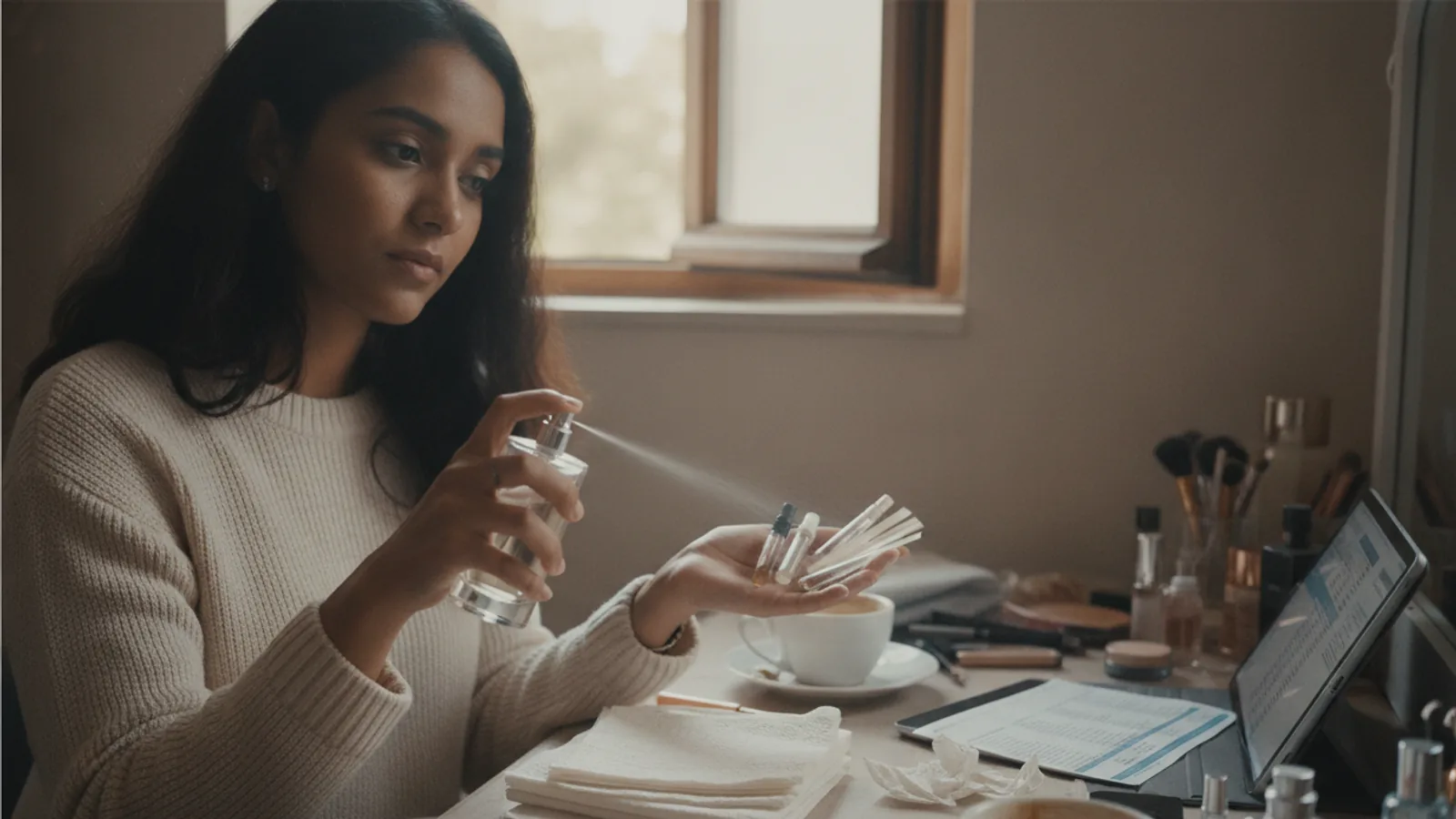
Hold the spray nozzle about six to eight inches from your skin and spray once, directly onto your inner wrist or the side of your neck. Avoid spraying multiple times or on your clothes, as that wastes juice and gives a skewed impression. Do not rub your wrists together after applying; this action generates friction that crushes the delicate top notes and speeds up their evaporation. A good check is to wait about 30 seconds and then bring your wrist to your nose without touching it, to experience the initial burst. This check matters because the top notes are the first impression, and they vanish within minutes. If you rub, you lose that experience and also alter the scent's development. By applying correctly, you allow the fragrance to unfold naturally, giving you a true measure of its opening and eventual heart and base notes.
Wait for the Full Development
After applying, resist the urge to sniff your wrist constantly. Instead, set a schedule to evaluate the scent at 30 minutes, 2 hours, and 5 hours. During this time, go about your normal activities, like working at a desk or taking a short walk. At each mark, bring your wrist to your nose and note the intensity and character. A practical check is to ask yourself: 'Is the scent still present? Has it changed from fresh to woody or sweet?' Do not judge the fragrance within the first 15 minutes because the top notes are not the whole story. This waiting period matters because a perfume is composed like a musical chord: the top notes fade to reveal the middle, and dry-down takes hours. If you make a decision too early, you might pick a scent that only smells good for a short time, leaving you with a bottle you dislike later. Patience is key to a wise investment.
Evaluate in Real-Life Context
A fragrance does not exist in a vacuum; it interacts with your surroundings, your body chemistry, and your activities. To test properly, wear the fragrance during a typical day, not just sitting at home. Go to work, run errands, or meet friends, as long as you stay in your comfort zone. At the 2-hour mark, ask yourself if the scent is pleasant to you and to people around you (if you are comfortable asking a trusted friend). A good check is to spray only once and see if it projects an arm's length away; if you cannot smell it after 5 hours, that tells you about its longevity. This real-life context matters because some scents work well in a quiet office but become overwhelming in a busy street, or they may fade quickly with physical activity. By evaluating in the real world, you learn how the fragrance performs in the conditions you actually live in, so you won't be surprised after buying a full bottle.
Record Your Impressions and Compare
Keep a simple journal or note on your phone with entries for each testing session. Write down the time, the fragrance name (if you are testing more than one, but ideally not), and your thoughts on each stage. After 6 hours, write a final summary: 'Would I want to smell this every day for a full bottle?' Use a rating scale, like 1 to 5, for longevity, projection, and overall likability. A practical check is to leave the tested wrist untouched overnight and sniff again in the morning, noting how it fades. This analysis matters because your immediate reaction is influenced by mood and environment; a written record helps you see patterns. For example, you might notice that a scent is pleasant at first but becomes cloying after 3 hours, so you avoid buying it. By comparing your notes objectively, you make a decision based on evidence rather than impulse, ensuring you invest in a fragrance you'll truly enjoy using.
Quick Reference
| Situation | Action | Why it helps |
|---|---|---|
| You are at a store and want to test a fragrance on the spot. | Spray once on your wrist, wait 30 seconds, sniff, then walk away and return after 10 minutes to re-evaluate the heart notes. | Quickly sniffing a paper strip or buying immediately leads to a rushed verdict that ignores how the scent evolves on your skin. |
| You have a busy day ahead but still want to test a fragrance. | Spray once on the back of your hand instead of your wrist, so it won't wash off easily, and set reminders to sniff at 2 and 5 hours. | The back of the hand is less exposed to rubbing than the wrist, helping you get a reliable longevity reading even on a hectic day. |
| You tested a fragrance but made a quick decision after 15 minutes and now regret it. | Go back to the sample, spray a fresh dab on your skin, and wait a full hour before deciding again, focusing on the heart notes. | The initial burst fades quickly, and a rapid judgment often reflects only the top notes, which do not represent the fragrance's true character. |
Common Issues
- Testing too many fragrances in one session overwhelms your sense of smell, making it impossible to compare accurately.: Limit yourself to a maximum of two fragrances per day, and between tests, smell a coffee bean or your own clean skin to reset your nose.
- Applying the fragrance and then rubbing your wrists together crushes the top notes and alters the scent's development.: Let the fragrance dry naturally after spraying, and avoid any friction during the first hour. Gently wave your wrist in the air if you want to speed drying.
- Judging a fragrance from the first five minutes leads to picking a bottle that only smells good as a top note, and the later stages disappoint you.: Commit to a full 5-hour test schedule and make notes at each stage. Never buy a full bottle until you have worn it through an entire day.
Advanced Tips
- Try testing a fragrance on two different skin spots at the same time, like one wrist and one inner elbow, to see how temperature differences change the scent.
- When at home, test a fragrance in response to different activities, like after a light workout or after a warm shower, because skin temperature and humidity affect performance.
- After testing, keep the test strip or a note about the fragrance in a small ziplock bag to revisit its scent after a few days, which can reveal a more relaxed impression.
Final Checklist
- Prepared clean, dry skin with no other scented products on the test area.
- Chose a calm day with at least six hours free to observe the full evolution.
- Applied only one spray, at the right distance, and without rubbing the area.
- Recorded impressions at 30 minutes, 2 hours, and 5 hours, and waited 24 hours before making a final decision.
FAQ
How long should I wait before deciding if I like a fragrance?
You should wait at least 5 hours, but ideally a full day. The initial top notes fade within 15 minutes, revealing the heart notes that last several hours. Base notes can linger for many hours or even days. By waiting at least 5 hours, you experience the complete lifecycle and can judge longevity and dry-down accurately.
Can I test a fragrance on paper instead of my skin?
Paper only gives you a rough idea of the top notes. Your skin's chemistry, temperature, and natural oils dramatically alter the scent's development. For a reliable test, you must apply it to your skin. If you are in a store, spray once on a paper strip to get an initial sense, but always follow up with a skin test before considering a purchase.
What should I do if a fragrance smells completely different after an hour?
This is normal because fragrance is structured in layers that evaporate at different rates. The top notes disappear to reveal the heart, which then gives way to base notes. If you are surprised by the change, use this as useful information: note whether the later stages are pleasant to you. If the dry-down is unpleasant, avoid buying the full bottle, as you will have to wear it for hours.