How To Choose A Beauty Product Patch Test Routine For New Formulas
A practical step-by-step guide to how to choose a beauty-product patch-test routine for new formulas, including preparation, instructions, common issues, tips, and next steps.
How To Choose A Beauty Product Patch Test Routine For New Formulas
Choosing a patch-test routine for a new beauty formula helps you catch irritation, allergies, or breakouts before you apply the product to your entire face or body. A patch test is a small, controlled trial that you do on a discreet area of skin, usually for a few days or up to a week. This guide walks you through selecting the right spot, preparing your skin, applying the product correctly, observing reactions, and deciding whether the formula is safe for regular use. You will also learn what to do if irritation occurs, how to test for different product types, and how to keep accurate notes. The goal is to build a habit that protects your skin and helps you choose products with confidence, no matter how many new formulas you try.
Fast Answer
- Patch-test every new formula for at least 3 to 5 days on a small area like your inner forearm or behind the ear, using a pea-sized amount once or twice daily, and watch for redness, itching, burning, or bumps before using it on your face or body.
- Choose a clean, dry patch area that you can leave undisturbed; apply a thin layer, cover it with a bandage if needed, and check the spot after 24 hours and again after 72 hours, then continue testing for a full week if no reaction appears.
Before You Start
- Select a small, easily hidden area for the test, such as your inner forearm, the crease of your elbow, or behind your ear, and avoid areas near your eyes, mouth, or broken skin.
- Read the product's ingredient list and look for known irritants like fragrance, alcohol, essential oils, or strong acids; if you have allergies, cross-check the list with your known triggers.
- Clean the skin and your hands with a mild, fragrance-free cleanser, then pat dry; do not apply any lotions, serums, or exfoliants to that spot for at least 24 hours before starting.
- Gather a timer or calendar, a small notepad or phone for notes, a gentle bandage or non-adhesive dressing, and a plain moisturizer to use if your skin becomes dry or irritated.
Step-by-Step Instructions
Pick a Hidden Test Spot
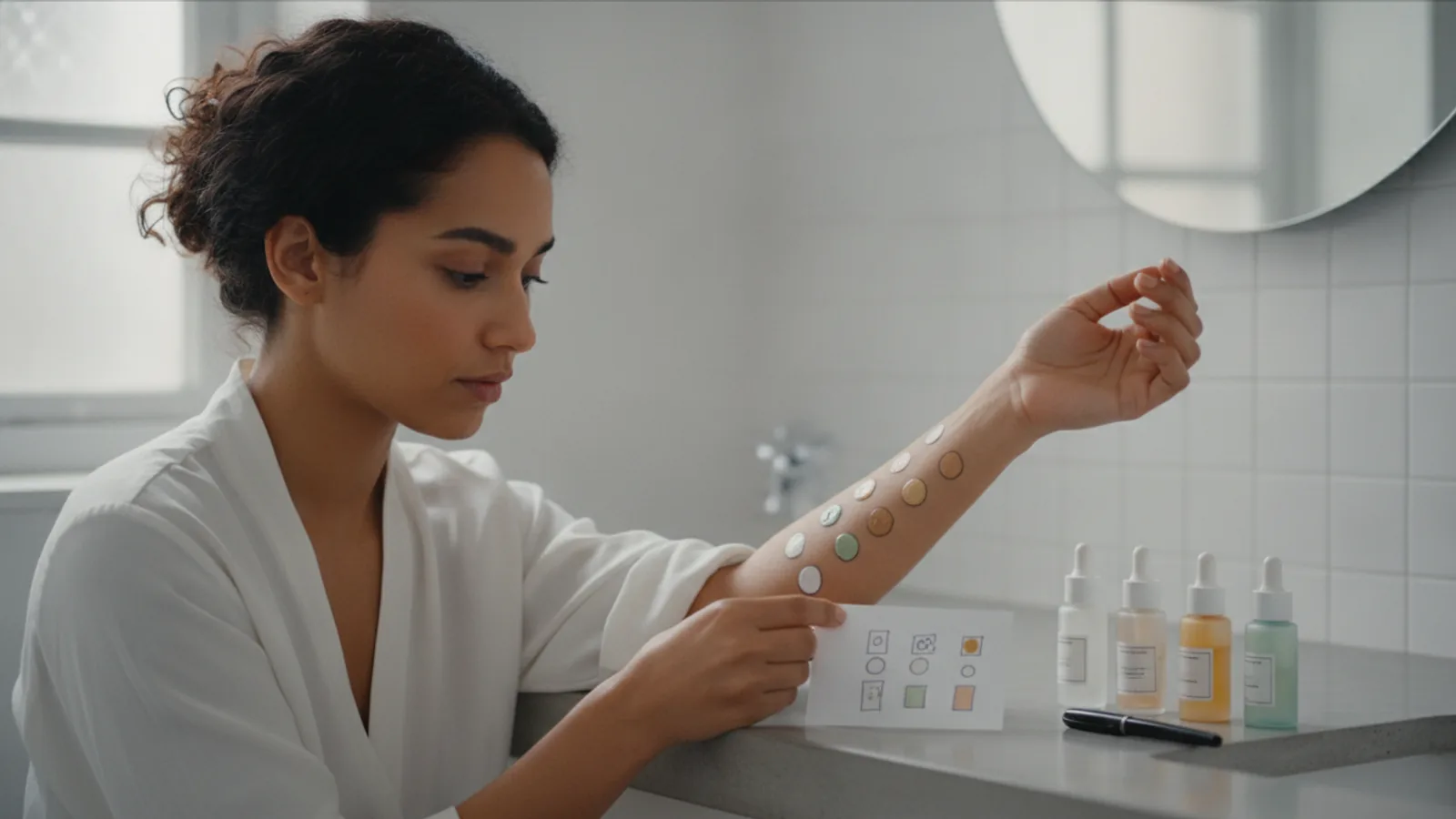
Choose a location for your patch test that is easy to cover and observe. The inner forearm is a classic choice because it is accessible and less exposed to sun or friction. Another option is behind the ear, which is a bit more sensitive and can give an early warning for facial products. Avoid spots that you shave, that have visible veins, or that are prone to eczema or psoriasis. The chosen area should be hair-free or only lightly haired, without any cuts, sunburn, or active breakouts. Also, avoid using that area for any other topical product during the test period. You want the results to be clear and not influenced by other factors. If you are testing a product intended for the face, some people use a small area near the jawline or just in front of the ear, but the forearm is easier to see and less likely to be accidentally touched. Check that the area is clean and dry before starting.
Clean and Dry the Area
Wash the patch test area with a gentle, fragrance-free cleanser and warm water for at least 30 seconds, then rinse well. Avoid using hot water, as it can irritate the skin. Pat the area dry with a clean towel, but do not rub. Wait at least 15 minutes to ensure the skin is completely dry and has returned to its normal pH. If you have just showered or exercised, wait longer because sweating or residual moisture can alter the absorption of the product. Do not apply any toner, serum, moisturizer, or other treatment to the area during the test, unless it is a product designed for patch testing. The goal is to have a clean, neutral surface so that any reaction you see can be attributed solely to the new formula. If you accidentally apply another product, you may have to restart the test after a 24-hour break. This step is crucial for accurate results.
Apply a Small Amount
Squeeze out a pea-sized amount of the product and spread it thinly over a quarter-sized area of skin. For a serum or liquid, use a drop; for a cream, use a small dab; for a mask, use a thin layer. Rub it in gently, just as you would on your face, but keep the layer even and not too thick. Do not cover a large area; the test is to see how your skin reacts to the formula in a small, localized spot. If the product is meant to be washed off (like a cleanser or mask), apply it and leave it on for the recommended time (usually 5 to 10 minutes), then rinse with lukewarm water and pat dry. For leave-on products, apply and leave it uncovered or cover with a bandage according to your preference. Do not apply more than the recommended amount, as that could cause a false reaction. After applying, mark the spot with a bit of tape or a pen (outside the area) to help you locate it later.
Monitor for 24 Hours
Leave the product on for 24 hours without washing the area, unless the label says to rinse off. For rinse-off products, after the initial contact, you can wash it off, but then do not reapply anything until the next observation. Set a reminder to check the patch area at the 24-hour mark. Look for any redness, itching, swelling, bumps, hives, or a burning sensation. Take a photo if possible, because early redness may be faint. If you see any of these signs, remove the product immediately, wash the area, and do not continue the test. If there is no reaction, you still do not have the full picture; some reactions take longer to appear. You may continue to leave the product on, or if you prefer, you can cover it with a bandage to protect it from friction and external irritants. The goal is to observe the immediate response: what happens in the first day often indicates irritant contact dermatitis.
Extend Testing to 72 Hours
At the 72-hour mark, check the patch area again under good lighting. By this time, allergic contact dermatitis, which is a delayed hypersensitivity reaction, may begin to show. Look for tiny blisters, dryness, scaling, or a rash that was not there at 24 hours. If you have been leaving the product on, continue to apply it once or twice daily as directed on the label, but only to the same small spot. If you have been using a rinse-off product, you can reapply it once a day for the next few days, but always wait 24 hours between applications. Do not use more than recommended. If any reaction appears, stop and treat the area with mild moisturizer or an over-the-counter hydrocortisone cream (unless you have a condition that prevents it). The 72-hour window captures most immediate and common delayed reactions, giving you a solid indication of whether the product is safe for continued use.
Complete a Full Week and Decide
For a thorough patch test, continue to expose the same area to the product for a total of 7 days. This is especially important for products with active ingredients like acids, retinol, or strong botanical extracts, which may cause reactions only after several days. Keep using the product as you normally would, but only on the tiny patch area, and keep a daily log of any changes, such as dryness, flaking, or itching. If after 7 days there is no reaction, it is likely that you can use the product on a larger area. However, even then, start slowly: on the first full application, use a thin layer over one cheek or a small part of the face, and observe for another 24 hours. If you notice any irritation, discontinue use. This extended test reduces the risk of a surprise reaction when you apply it to your whole face.
Quick Reference
| Situation | Action | Why it helps |
|---|---|---|
| You are trying a new facial serum that contains vitamin C or retinol, and you have sensitive skin. | Patch test on the inner forearm for 5 to 7 days, applying a pea-sized amount every evening, and do not use any other active products on that area. | Active ingredients can cause mild irritation that builds up over a few days; testing daily for a week gives time for reactions to appear before you risk your entire face. |
| You are testing a new body lotion or sunscreen and you need to know if it will break you out or cause itching. | Apply a thin layer to a 3- to 4-centimeter area on your upper chest or the inside of your elbow daily for 4 days, and inspect for redness or bumps each morning. | The skin on these areas is more sensitive than arms but less sensitive than the face, giving a realistic reaction without exposing large areas to a potential irritant. |
| You have a history of allergic reactions to a specific ingredient, and you want to test a new product that might contain a similar compound. | Do a 'use test' by applying the product to the antecubital fossa (inside of the elbow) twice a day for 7 days, and do not cover it with a bandage unless necessary. | The inside of the elbow has thin, permeable skin that often reacts strongly to allergens, and a week gives time for T-cell mediated allergic responses to develop. |
Common Issues
- Mild redness appears at the patch site after 6 hours, but you are unsure if it is irritation or just from the tape or bandage.: Remove the bandage and stop applying the product for the rest of the day. Wash the area with mild soap, pat dry, and do not apply anything else. If the redness fades within 12 hours, it might have been mechanical. However, if it persists or starts to itch, discontinue the test and consider the product a potential irritant.
- You see no reaction for 72 hours, but on the fourth day a few tiny bumps appear at the test spot.: Stop using the product immediately. Clean the area gently and apply a fragrance-free moisturizer to soothe it. Do not try to 'power through' the test. The delayed bumps indicate a sensitization reaction. Wait at least two weeks before considering another test with a different product, and consult a dermatologist if the bumps itch or spread.
- You are patch testing a product meant for the face, but the product stings on your forearm, which has never had a reaction before.: Trust the stinging sensation. It may be a sign that the product's pH is too high or low, or that an ingredient is too strong for any skin, not just your face. Discontinue the test and wash the area. Do not apply the product to your face. Consider diluting the product slightly or choosing a milder formula.
Advanced Tips
- For a more accurate allergy test, perform a repeated open application test by applying the product to the same spot twice daily for up to two weeks, but do not cover it with a bandage unless you are testing a potential irritant that you normally would cover.
- If you are testing a leave-on product, consider applying it to the crease of your elbow and leaving it uncovered, then applying a barrier cream such as zinc oxide beyond the area to prevent spread.
- Keep a detailed diary that includes the date, time, amount used, and any other products you applied that day; this will help you trace a reaction back to a specific variable if something goes wrong.
Final Checklist
- Choose a hidden area (forearm or behind ear) and mark it with a circle of tape.
- Cleanse the area with mild, fragrance-free soap and let it dry completely.
- Apply a pea-sized amount of the product daily for 7 days, checking every 24 hours.
- Record any redness, itching, or bumps, and stop immediately if any reaction occurs.
FAQ
How long should I patch test a new beauty product before I use it on my face?
For most products, a minimum of 4 days is recommended, but a full 7-day test is safer, especially for active ingredients like retinol or vitamin C. Some allergic reactions take up to a week to appear. Even after a 7-day patch test, start using the product on a small area of your face and wait another 24 hours to watch for a reaction before applying it everywhere.
Can I test multiple new products at the same time on different spots?
It is possible to test multiple products on separate spots, but it is not ideal because if a reaction occurs, you will not know which product caused it. Also, you may inadvertently cross-contaminate the spots. If you want to test more than one, use separate areas far from each other, such as one on each inner arm, and label them clearly. Keep a log of which product is on which spot.
What should I do if I get a severe reaction during a patch test?
Immediately wash the area with mild soap and water, then apply a cool compress. Do not apply any other product unless it is a plain moisturizer. Take an antihistamine if you have one and the reaction is itchy, but only if it is safe for you. If the reaction is severe—with large blisters, swelling of the face or throat, or difficulty breathing—seek medical help right away. After any reaction, note the product name and the symptoms so you can avoid it in the future.