A Fragrance Test Before Committing To A Full Bottle Checklist For First Time Readers
A practical step-by-step guide to a fragrance test before committing to a full bottle checklist for first-time readers, including preparation, instructions, common issues, tips, and next steps.
A Fragrance Test Before Committing To A Full Bottle Checklist For First Time Readers
This step-by-step guide helps first-time fragrance buyers test a scent properly before buying a full bottle. It explains how to warm up your skin, apply the fragrance to the right pulse points, and evaluate it over several hours. You will learn to check sillage, longevity, and how the scent changes from top notes to base notes. The guide also covers common mistakes, quick fixes for issues like nose fatigue, and advanced tips for layering or storing perfumes. By following this checklist, you can confidently decide whether a fragrance truly suits your skin chemistry and daily life, avoiding costly impulse purchases and ending up with a scent you genuinely love.
Fast Answer
- Test fragrance on your skin, not on paper, because body heat and oils change how the scent develops and lasts.
- Wear the fragrance for at least 4–6 hours, through different activities, to experience its full evolution from top to base notes.
Before You Start
- Choose a quiet day when you have at least 6–8 hours at home or in a low-stimulus environment, so you can focus on the scent without rushing.
- Gather an unscented lotion, a fragrance blotter or paper strip, and a pen to take notes on the fragrance's behavior over time.
- Do not wear any other fragrance on your skin or clothes for 24 hours before testing, so your nose and skin are neutral.
- Wash your forearms with unscented soap and dry them thoroughly; avoid scented moisturizers or deodorant on the test area.
Step-by-Step Instructions
Prepare Your Skin for Testing
Begin by washing your inner forearms with a mild, unscented soap. Pat them dry with a clean towel and wait five minutes for your skin to return to its normal pH. Apply a small amount of unscented lotion to each forearm and let it absorb completely. This step is crucial because fragrance bonds better with moisturized skin, which helps the scent last longer and prevents the alcohol in the perfume from evaporating too quickly. Dry or irritated skin can distort the fragrance, making it smell sharper or shorter-lived. The lotion also creates a neutral base, so you are smelling the true composition of the perfume rather than your skin's natural oils or any residual product. Avoid scented anything, as even a faint cream can interfere with the opening notes. By investing five minutes in this preparation, you give yourself a clean canvas that will honestly reflect how the fragrance will smell on you.
Apply the Fragrance to Pulse Points
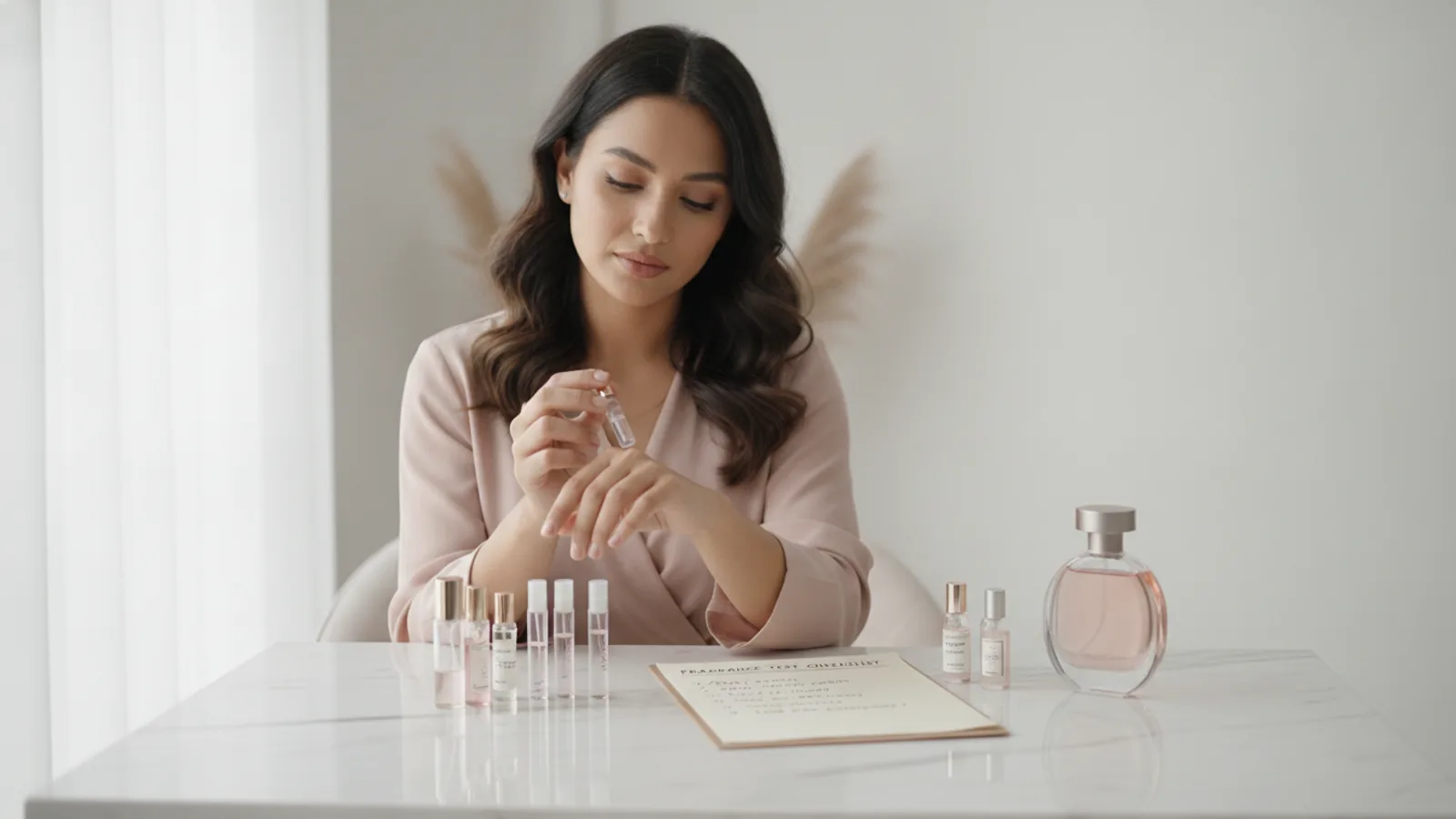
Spray or dab a small amount of the fragrance onto your inner wrists and the crook of your elbow on the same arm. Do not rub the fragrance, as rubbing generates heat and breaks down the delicate top notes. Instead, gently press the two wrists together once, or simply let the liquid dry naturally. Pulse points are places where your blood flows close to the skin, and they emit heat that helps project the scent. The inner wrist and elbow are ideal for testing because they are easy to smell without having to bring your nose too close. Apply only one spray per pulse point to avoid overloading your senses. If you are testing multiple fragrances, use one forearm for each scent and keep them separate, so you can compare them side by side without mixing. This application method mimics how you would normally wear the perfume, giving you a realistic impression of its intensity.
Smell Immediately for Top Notes
Within the first five minutes, bring your wrist close to your nose—about an inch away—and take a slow, shallow breath. You are smelling the top notes, which are the initial, volatile ingredients that last only 10 to 15 minutes. These are often fresh, citrusy, or light, and they give the first impression. Take a mental or written note of what you detect: is it sharp, sweet, herbal, or something else? Pay attention to whether you like this initial burst, because if you dislike the top notes, the scent will not become more pleasant later. However, do not judge the fragrance solely on these fleeting notes, as they fade quickly. Instead, use this moment to assess how the fragrance opens and whether it feels pleasant on your skin. If the top notes are overwhelming or irritating, that is a warning sign. This check matters because a fragrance you love at first sniff might turn sour later, and a rough opening might soften into a beautiful dry down.
Assess the Heart Notes After Half an Hour
Let the fragrance settle for 30 minutes, then smell your wrist again without pressing it against your nose. The heart notes, or middle notes, are now emerging, and they form the core of the fragrance, lasting for several hours. These notes are usually softer, floral, spicy, or woody, and they balance the initial brightness. This is the time to evaluate whether the fragrance feels comfortable and integrated with your skin. Ask yourself: Does the scent become more appealing, or does it clash with your natural body chemistry? The heart notes are the real personality of the perfume, so it is essential to like them for a long-term wear. Check if the projection has changed, whether it is still close to the skin or filling the room. Use this step to decide if the fragrance is suitable for the occasions you have in mind, such as daily office wear or evening outings. This evaluation prevents you from buying a bottle based solely on the opening, only to be disappointed after an hour.
Evaluate Base Notes and Longevity on Dry Skin
Wait at least four to six hours after application and then check your wrist again. By now, the top and heart notes have faded, revealing the base notes, which are the fundamental, long-lasting ingredients like woods, musk, amber, or vanilla. These notes cling to your skin and determine how the fragrance lingers throughout the day. Note whether the scent has become faint, moderate, or still strong, and whether the dry down is pleasant or cloying. Also, check how far the scent projects; it might be now an intimate aura or barely detectable. This is the most critical step because you are evaluating the fragrance's true skin-scent, which is what people will smell on you hours after application. If the base notes are not to your liking, any perfume will eventually disappoint you. Also, see if the fragrance maintains its integrity or turns sour, powdery, or overly sweet. This step ensures you know what you are committing to for a full day.
Simulate Real-Life Wear During the Full Day
To truly understand the fragrance, wear it for an entire day, from morning to evening, in a place where you interact with others. Apply it before you got to work or run errands, and maintain your normal routine. At regular intervals, ask someone whose opinion you trust what they smell from a comfortable distance, so you know its sillage in social situations. Additionally, test the fragrance during physical activity, as heat and sweat can alter its intensity and character. If it is intended for special events, you can dress up, but normal daily stress is a better test. This extended trial lets you observe how the fragrance fades, how often it needs reapplying, and whether it gives you a headache after a few hours. It also reveals if the scent interferes with your appetite, mood, or interactions. A fragrance that you enjoy for an hour may become irritating by the end of the day, so this final evaluation is essential before making a purchase.
Quick Reference
| Situation | Action | Why it helps |
|---|---|---|
| You are at a store and want to test a fragrance quickly before buying | Spray the scent on a paper strip, but also spray one spray on your inner wrist, then take at least 20 minutes to walk around and smell the wrist periodically before deciding | The paper strip shows only the top notes, while your skin reveals how the fragrance blends with your warmth and oils, so you get a realistic preview of the dry down. |
| You have purchased a bottle and the scent seems to disappear quickly on you | Moisturize your skin with an unscented lotion before applying the perfume, and spray on pulse points like your neck and insides of your wrists, avoiding rubbing the wrists together | Dry skin lacks natural oils that hold fragrance molecules, so hydration helps the perfume last longer, and pulse points radiate heat that helps the scent project. |
| You cannot smell a fragrance on yourself after a few hours, even though you like it | Ask a friend or family member to tell you if they can still smell the fragrance on you from an arm's length, and avoid smelling your own skin constantly to prevent nose fatigue | Your nose adapts to a constant scent and stops registering it, but others can still detect it, so getting an outside opinion tells you how strong the sillage truly is. |
Common Issues
- The fragrance smells strong immediately after application but fades within an hour: Check if you are spraying on dry, sensitive skin; if so, apply a fragrance-free moisturizer first. Also, avoid spraying on clothes, because fabric does not project as well. Spray on warm pulse points and reapply only when necessary, but if it vanishes even with proper hydration, the fragrance may have a short longevity by design.
- You get a headache or feel nausea after wearing a scent for a few hours: Reduce the number of sprays to one or two, and apply it to the back of your neck or inside your elbows rather than directly under your nose. Make sure you are not layering the fragrance with other scented products, and test with lighter, fresh fragrances. If headaches persist, you may be sensitive to certain synthetic musks, so try a different composition.
- You cannot tell if the fragrance smells the same on you as it does on a paper tester: Remember that skin chemistry changes each perfume due to pH, oil levels, and body heat. To compare, apply the fragrance to your skin and also on a paper strip, then wait at least an hour and smell both. If the difference is huge, your skin may hold onto certain notes like musk or woods, which can be desirable. Trust how it smells on your skin for a full day.
Advanced Tips
- Layer your fragrance with an unscented body lotion or a matching scented body oil to intensify its longevity without altering its character, but do not combine multiple strong perfumes.
- Keep your fragrance in a cool, dark place away from air and direct sun, such as a drawer or closet, because heat and light can degrade the delicate notes over time.
- Learn to recognize the three fragrance families—fresh, woody, and oriental—and use that knowledge to choose a scent that fits your personality and the seasons, rather than buying blind.
Final Checklist
- Test the fragrance on clean, moisturized skin and wait 30 minutes to experience the heart notes before making any judgment.
- Wear the fragrance for at least 6 hours, evaluate the base notes, and note its longevity and projection on your skin.
- Get a second opinion from someone you trust about the sillage and how the scent evolves over the day.
- Only purchase a full bottle if you love the scent at the end of the day and it suits your daily routine and budget.
FAQ
How many fragrances should I test in one store visit?
Stick to no more than two or three fragrances per visit, and ideally spread them over different times of the day. Testing too many scents overwhelms your olfactory senses, making it hard to distinguish subtleties. You can smell coffee beans in between tests to reset, but that only works briefly. The best approach is to test one on each arm, wait 30 minutes, and then decide which one to continue wearing for the rest of the day.
Is it better to test perfume on a paper strip or directly on skin?
Always test on your skin before buying a full bottle. Paper strips are useful for a quick initial sniff of the top notes, but they lack the warmth and oils that interact with the perfume. On skin, the fragrance evolves, and the dry down can be entirely different. A paper strip will not tell you how the scent lasts on your body, so for a confident purchase, you must wear it on your skin for several hours.
What should I do if a fragrance gives me a rash or irritation?
Wash the area with mild soap and water immediately and stop using the fragrance. Apply a soothing, unscented lotion or aloe vera to calm the skin. The rash might be due to an allergic reaction to certain compounds, like specific aldehydes or essential oils. Avoid that fragrance and wait for the skin to heal before testing another. Consult a dermatologist if symptoms persist. You may prefer to test new perfumes on a small area like your inner elbow and wait 24 hours to ensure no adverse reaction.